
Inside the courtroom on Monday, eight justices wrangled with what Boulder, Colorado’s lawsuit against ExxonMobil and Suncor Energy is actually about — a question that has plagued similar lawsuits across the country since their inception. The court’s answer may determine the fate not only of Boulders’ case, but of dozens of other lawsuits that argue oil companies should pay for deceiving the public about the climate risks of burning fossil fuels.
The dispute stems from the oil companies’ longstanding efforts to frame the cases as a backdoor attempt to regulate greenhouse gas emissions. They argue that the lawsuits are preempted not just by federal statute under the Clean Air Act but by the “structure of the Constitution” — a theory that could reach into state-level cases against powerful industries beyond just oil and gas.
During the arguments in Suncor v Boulder, both liberal and conservative justices likened Boulder’s case against Exxon and Suncor to historic state lawsuits that sought to recover damages from other major corporations. Some justices indicated skepticism of the companies’ arguments that the lawsuit should be thrown out before a trial.
Justice Elena Kagan observed at one point that “this suit appears to be based on the old 1990s tobacco suits that were brought by states and local governments,” as well as opioid litigation.
Suncor and Exxon’s attorney, Kannon Shanmugam, argued that the climate cases are a “very different book… not a chapter in the same book” as tobacco and opioid litigation. But Kagan remained skeptical, saying that she was “waiting to see the distinction.”
"This suit appears to be based on the old 1990s tobacco suits that were brought by states and local governments," said Justice Elena Kagan.
Chief Justice John Roberts also questioned how Boulder’s case differs from other state civil suits against multiple companies whose conduct causes harm across state borders. “I guess I'm not quite sure what makes this situation different from all those other ones where we've allowed them to proceed in state court,” he said.
Boulder’s attorney Kevin Russell maintained that “this case is not about emissions; it's about deception and producers” and follows a longstanding tradition of states seeking remedies for harm to their residents.
Even the most conservative justices seemed to be “struggling to understand how to distinguish this case from the other cases” like tobacco and opioids whose claims center around deceptive conduct, “and other well known examples of states playing an important role in this space,” said Chris Winter, executive director of the Getches-Wilkinson Center for Natural Resources, Energy, and the Environment at University of Colorado Law School.
The oil companies swung for the Constitution, and justices had doubts
A total victory for oil companies would be a broad ruling about the constitutionality of state climate lawsuits.
The companies’ constitutional argument against state lawsuits, which argues state law cannot apply to conduct that occurs in one state and causes harm in another, “has enormous consequences for state law” beyond just climate cases, said Pat Parenteau, a professor of environmental law and senior fellow for climate policy at Vermont Law and Graduate School. “God knows where it might apply and what it might strike down. That’s a limitless doctrine that they’re arguing.”
Likely because of these high stakes, both liberal and conservative justices pressed Shanmugam and Deputy Solicitor General Sarah Harris, who argued for the Trump administration, on the argument that climate lawsuits are blocked by the Constitution.
The argument doesn't rely on any existing constitutional text, said Kagan. “Where does this principle come from?” she asked. “Where is the text for that? Where's the support for that? Where's the precedent for that? Where's the anything for that?”
Justice Brett Kavanaugh, who appeared to otherwise agree with the oil companies, tried to steer the attorneys away from the argument, which he said goes “beyond our precedent.”
“There’s a lot of constitutional theory being tossed around, but we have four precedents... that make crystal clear that interstate air and water pollution are matters for federal law unless Congress specifically preserves state law,” he said.
“God knows where it might apply and what it might strike down. That’s a limitless doctrine that they’re arguing,” said environmental law professor Pat Parenteau.
The companies’ constitutional theory would ask the justices to “essentially announce a new limitation on the role of the states in this area of environmental protection” and “create a very broad new constitutional rule,” said Winter, of the University of Colorado Law School. Such a ruling would affect litigation against social media companies and PFAS litigation, he said.
Shanmugam, the oil companies’ lawyer, drew more attention to the constitutionality of the case than their other argument about federal preemption under the Clean Air Act. The Clean Air Act argument may be undercut by the Trump administration's drastic rollbacks of the EPA’s ability to regulate greenhouse gas emissions. “Our arguments concerning constitutional structure apply with full force, regardless of what EPA says,” Shanmugam said when questioned about switching between these arguments, a maneuver Justice Amy Coney Barrett called “a little slippery.”
Winter believes the Trump administration and oil companies’ attorneys were hesitant to draw too much attention to their Clean Air Act arguments because of the administration’s regulatory rollbacks and the “incredible vacuum” that would be left by also cutting down state climate cases. “It would leave the oil industry free to do what it wants with very little accountability under any level of government,” he said.
The many possible outcomes of this case
Several justices, including Justices Sonia Sotomayor, Ketanji Brown Jackson, and Clarence Thomas asked whether the court has jurisdiction to intervene in the case at all at this stage. “Why shouldn’t we wait and hear all of these claims once the state courts are done with their federal considerations?” asked Jackson.
Shanmugam argued that the justices should decide on the case now “given the extraordinary magnitude” of the lawsuits against oil and gas giants and the threat of billions of dollars in damages. Just last week, he pointed out, Middlesex County, New Jersey filed a new case against oil companies seeking to recover local climate costs.
The conservative justices also expressed concern about a potential crush of climate lawsuits if Boulder’s case is allowed to move forward. “Presumably, if you prevail, the next day a municipality in every single state will file a lawsuit,” Roberts told Russell, Boulder’s attorney.
Without Justice Samuel Alito’s vote (Alito recused himself a week before the argument), there is a possibility the court is ultimately split 4-4 in a decision. It also is possible the court rules narrowly or broadly in a way that blocks future state climate lawsuits.
The justices could rule that Boulder’s case should move forward, they could rule in a way that would dismiss some claims while preserving others, or they could order that the case be dismissed in its entirety, effectively killing others like it before they can present full arguments and evidence at trial. The justices could also decide they do not have jurisdiction to rule on the case.
Between the EPA’s rollbacks of Clean Air Act regulations and the pending legislation by Congressional Republicans aiming to completely immunize oil companies from lawsuits nationwide, the court could be convinced that “now is not the time to decide this thing,” said Parenteau.
Ranchers, disaster survivors want oil companies to face a trial
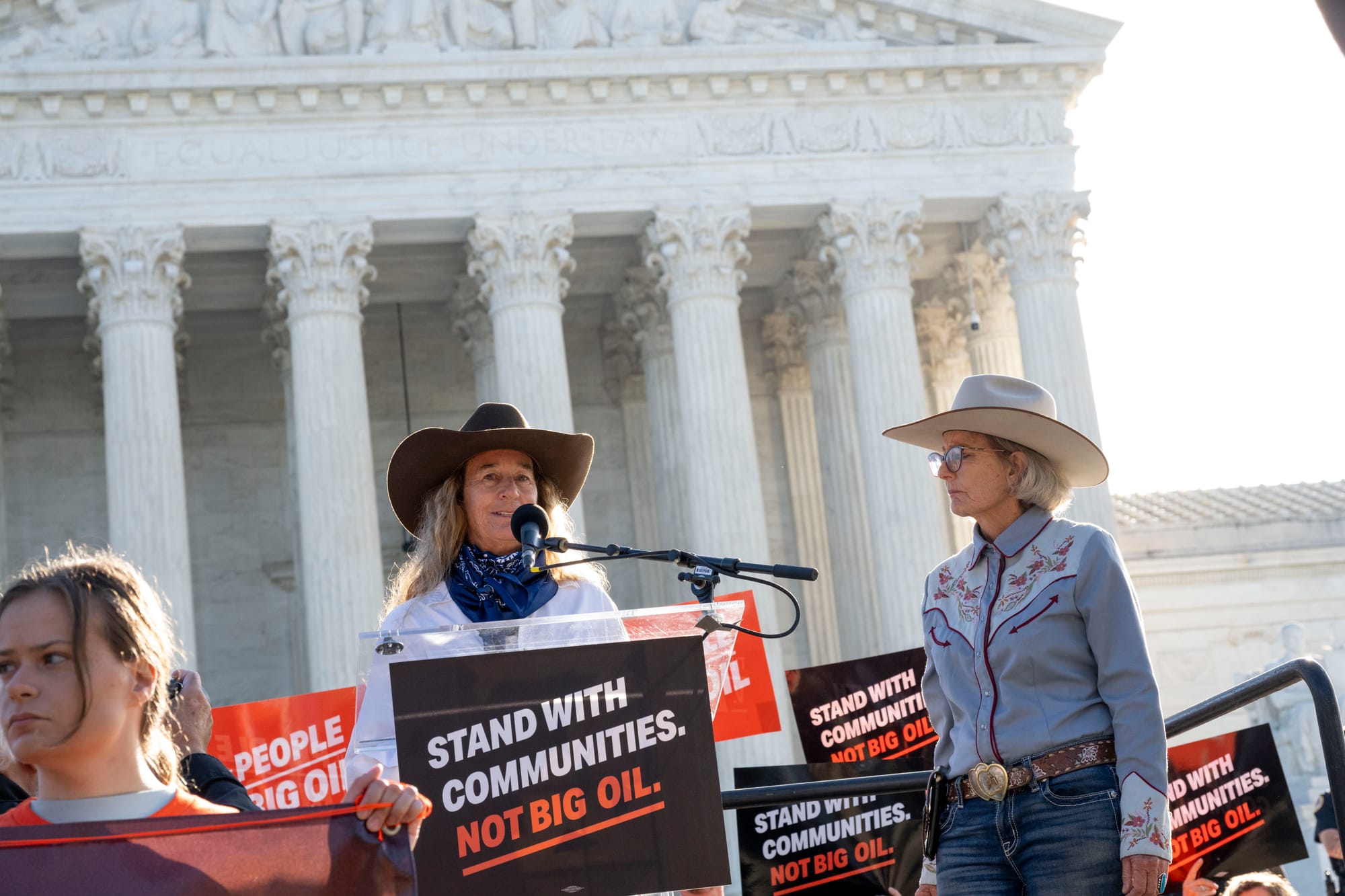
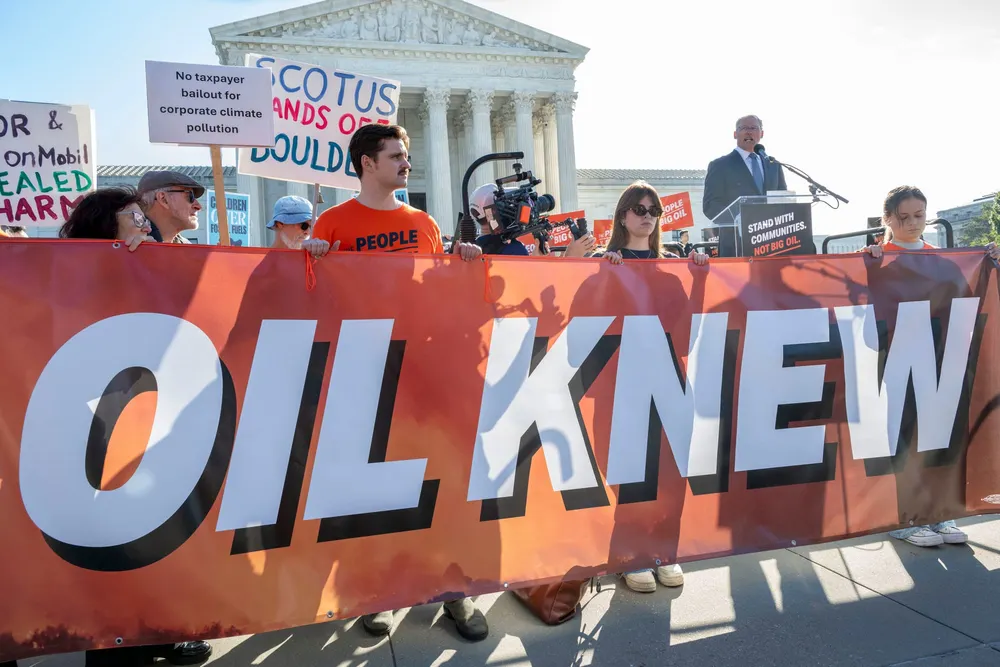
While the justices filed into the courtroom, Colorado ranchers and survivors of climate-fueled wildfires rallied for Boulder’s case outside the court.
Brutal wildfires and drought have wreaked havoc on many small, family-run ranches, said Deirdre Macnab, who joined other ranchers in filing a brief in support of Boulder’s case with the Supreme Court. Just before arriving at the nation’s capitol, she got a call that two wells on her ranch had dried up and were failing to provide drinking water for her cattle, she said in an interview before the rally.
Supporters of Boulder’s case have also included local government groups, 19 state attorneys general, tribal governments, and gun violence prevention groups. Some unlikely voices have expressed support for Boulder’s case to continue in state court, including conservative legal scholars and former EPA chiefs under Republican presidents.
After the arguments, Boulder city manager Nuria Rivera-Vandermyde spoke to reporters about the costs of floods, wildfires, extreme heat, and other threats to public health fueled by the burning of fossil fuels. “The people and institutions closest to these impacts should have a meaningful opportunity to present their evidence” of oil companies’ deception to the court, she said.